


I. What Is a Passive Optical Network (PON)
A passive optical network (PON) is a network architecture that connects the service provider-side optical line terminal (OLT) to multiple optical network units (ONUs) or optical network terminals (ONTs). Between the optical line terminal (OLT) and the user is the optical distribution network (ODN), mainly composed of optical fibers and passive optical splitters. Because the distribution network does not require active switching equipment, PON can efficiently serve multiple users from a single OLT port.
II. Definitions and Standards of GPON and EPON
In the evolution of PON technology, GPON and EPON are two main implementations:
-
GPON (Gigabit Passive Optical Network): defined by the ITU-T G.984 series of standards.
-
EPON (Ethernet Passive Optical Network): originally standardized in IEEE 802.3ah, now incorporated into the IEEE 802.3 Ethernet standard.
III. Core Technical Differences
The two technologies adopt different technical paths at the underlying architecture:
-
Encapsulation: GPON uses the GPON Transmission Convergence (GTC) layer and GPON Encapsulation Method (GEM); EPON is built directly around Ethernet frames.
-
Upstream access control: GPON uses T-CONT / DBA (Dynamic Bandwidth Allocation); EPON uses MPCP (Multi-Point Control Protocol) / DBA.
IV. Detailed Comparison of GPON and EPON
Based on their technical characteristics, the following compares them across multiple dimensions:
| Factor | GPON | Ethernet Passive Optical Network |
|---|---|---|
| Standard family | ITU-T G.984 Recommendations | IEEE 802.3 |
| Typical downstream line rate | 2.488 Gbit/s | 1.25 Gbit/s |
| Typical upstream line rate | 1.244 Gbit/s | 1.25 Gbit/s |
| Ethernet data rate after line coding | — | 1 Gbit/s |
| Encapsulation | GTC / GEM | Native Ethernet |
| Upstream access control | T-CONT / DBA | MPCP / DBA |
| Typical physical split | 1:32 / 1:64 | Usually up to 1:32 |
| Typical access range | Up to about 20 km | Up to about 20 km |
| Downstream wavelength | 1480–1500 nm | 1480–1500 nm |
| Upstream wavelength | O-band, wavelength about 1310 nm | O-band, wavelength about 1310 nm |
| Management/interoperability | OMCI and vendor platform support | Ethernet OAM/MPCP and vendor implementation |
| Cost | Deployment method depends on specific circumstances | Deployment method depends on specific circumstances |
V. Summary
GPON and EPON are consistent in wavelength planning (downstream 1480–1500 nm, upstream O-band about 1310 nm) and typical access range (up to about 20 km). The main differences lie in the standard system, line rates (GPON has a higher downstream rate of 2.488 Gbit/s; EPON is symmetric upstream and downstream at 1.25 Gbit/s, with a coded data rate of 1 Gbit/s), encapsulation structure, and management protocols.
In terms of physical split, GPON supports 1:32 and 1:64, while EPON usually supports up to 1:32. In management and interoperability, GPON relies on OMCI and vendor platform support, while EPON relies on Ethernet OAM/MPCP and vendor implementations. As for cost, both depend on specific deployment circumstances and cannot be generalized.
Related Posts
- PON-BASED GPON ARCHITECTURES INTRODUCTIONS
PON architectures for FTTH deployments are currently based on passive optical splitters to distribute the bandwidth to each customer using fiber splitters providing ratios ranging up to 1:64 or even 1:128. The physical PON FTTH architecture typically supports the Ethernet protocol. PON network feeds a variety of optical network terminations…
 Strong GPON OLT Demand Indicates Increasing FTTH Buildouts
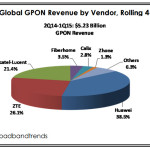
Global GPON revenue declined 7 percent quarter-over-quarter to reach $1.32 billion. This decline was primarily associated with declining ASPs across all regions. Year-over-year, revenue increased by 32 percent. Asia Pacific continues to drive the majority of demand, where China is currently in the process of large scale FTTH deployments due…
- XPON Technologies Compared: GPON, EPON, XG-PON, and XGS-PON
XPON (Passive Optical Network) is an umbrella term for a class of fiber access technologies that use a point-to-multipoint architecture. Its core characteristic is that the central office (OLT) and the user side (ONU) are connected by a passive optical distribution network (ODN), with no active electronic equipment required anywhere…
 FTTx Distribution Architectures: Centralized and Distributed Split Comparison
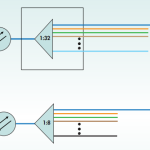
Splitter-based FTTx architectures are a compromise between cost and the flexibility of running fiber to every subscriber location. Instead of running fiber from the central office/ headend to every home like in a P2P arrangement, which is extremely expensive, splitter-based architectures run a single fiber from the headend/central office out…
 GPON & GEPON Comparison table
GPON GEPON COMPREHENSIVE COMPARISON TABLE Comparison GPON GEPON GPON GEPON Basics ITU Standard G.984 ITU Standard G.987 for 10Gbits Downstream 10Gbits/s, Upstream 2.488/10Gbits/s Uses GPON Encapsulation Method (GEM), fragmented packets or ATM (most implementations use GEM as ATM is expensive) Sometimes called GEPON (Gigabit Ethernet Passive Optical Network) IEEE 802.3 standard,…