

These four cable types are common interconnect solutions used in data centers and AI clusters for high‑speed data transmission. Their primary differences lie in the transmission medium (copper or optical fiber) and the signal enhancement method (passive, active analog, or active digital), which determine their performance in terms of transmission distance, cost, and power consumption.
Core Concepts
-
DAC (Direct Attach Copper Cable) – Passive copper cable. This is the most basic solution, consisting only of copper wire and connectors at both ends, with no active electronic components. Signals are transmitted directly over the copper without any external power.
-
ACC (Active Copper Cable) – Active copper cable. It builds on DAC by integrating signal driver (Redriver) chips at both ends. These chips use analog amplification and equalization to compensate for signal attenuation over copper.
-
AEC (Active Electrical Cable) – Active copper cable. Similar to ACC, but it incorporates more advanced Retimer chips. Retimers use digital signal processing to not only amplify but also retime, reshape, and re‑drive the signal, effectively eliminating jitter and noise.
-
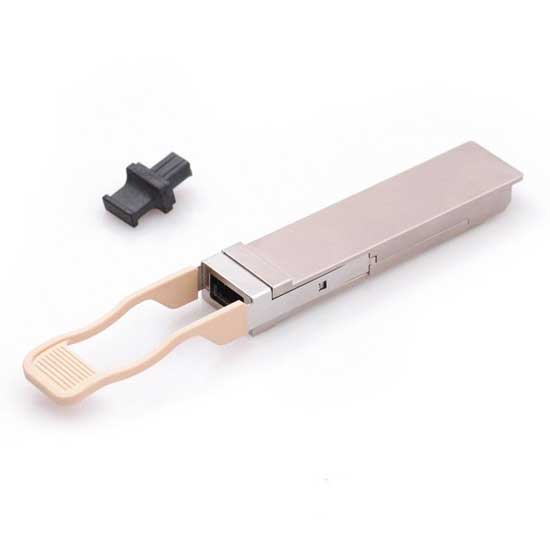
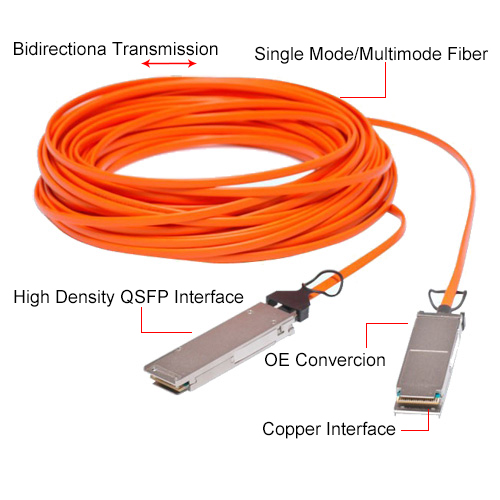
AOC (Active Optical Cable) – Active optical cable. It uses optical fiber as the transmission medium, with electro‑optical conversion modules at both ends. Electrical signals are converted to optical signals for transmission over fiber and then converted back to electrical signals at the receiver.
Comparison Table
| Feature | DAC (Passive Copper) | ACC (Active Copper) | AEC (Active Electrical Cable) | AOC (Active Optical Cable) |
|---|---|---|---|---|
| Transmission Medium | Copper | Copper | Copper | Optical Fiber |
| Signal Enhancement | None | Active, analog amplification (Redriver) | Active, digital retiming (Retimer) | Active, electro‑optical conversion |
| Power Required | No | Yes | Yes | Yes |
| Transmission Distance | Short (2‑3 m, up to 5‑7 m) | Short‑medium (2‑5 m) | Medium (4‑9 m) | Long (100 m – 10 km) |
| Cost Level | Low | Medium‑low | Medium‑high | High |
| Power Consumption | Very low (~0 W) | Low | Moderate | High |
| Cable Bulk / Weight | Bulky, heavier | Bulky | Compact, lighter | Very compact, lightweight |
The decision depends mainly on your transmission distance, budget, and power constraints.
-
DAC – The optimal choice for very short connections within the same rack. It offers the best cost‑performance and energy efficiency.
-
ACC / AEC – Balanced options for between racks or adjacent racks (medium distances). They provide lower cost and power than AOC, and better signal integrity than DAC over longer runs.
-
AOC – The only choice for long‑distance connections across racks or between buildings, but it comes with the highest cost and power consumption.
Decision Logic
-
Distance is the primary factor. For the shortest distances where DAC works, it is the clear winner.
-
When distance increases and signal boosting is needed, choose between ACC and AEC based on your tolerance for cost, power, and performance.
-
Once the distance exceeds the copper limit (roughly 7–9 m), AOC becomes the only viable option.