

When network issues arise in AI data centers, switches, transceivers, and software settings are often the first suspects. However, one tiny culprit is frequently overlooked: dirty fiber connectors. In 400G and 400G networks, even minuscule dust particles can degrade signals, increase error rates, and cause link failures. As AI clusters scale up, fiber cleaning has become a fundamental yet essential practice for ensuring stable and dependable network performance.
Why Fiber Cleaning Deserves More Attention in AI Data Centers
Today’s AI data centers depend on 400G and 800G optical interconnects to power high‑performance GPU clusters and handle the massive east‑west traffic generated by AI training and inference. With AI networks demanding lower latency, higher bandwidth, and stronger link stability, the quality of fiber optic connections has become a major factor in overall data center performance.
At speeds of 400G and 800G, even microscopic contamination on fiber end faces can distort optical signals, boost bit error rates, and create link instability. These problems can lead to data retransmissions, added troubleshooting time, and lower GPU utilization across the network. Routine fiber inspection and cleaning help maintain reliable optical links, improve network performance, and ensure that AI data center infrastructure runs efficiently.
Common Causes of Fiber Contamination
Human Handling
Contamination often enters during installation, when handling connectors, or during routine plugging and unplugging of patch cords. Oils, dust, and other particles can transfer from fingers, tools, or work surfaces onto the connector end face. Removing protective caps too early or leaving connectors exposed during maintenance further raises the risk of contamination. Repeated mating and unmating can also transfer pollutants between interfaces, affecting long‑term link reliability.
Environmental Dust
Airborne dust and particles in the operating environment are another major source of fiber contamination. Dust can settle around racks, cabling areas, and equipment, or get stirred up during regular maintenance activities. Even microscopic particles can partially block the optical path and weaken signal transmission, posing an even greater challenge for high‑speed AI data center networks.
How Contaminated Fibers Affect AI Network Performance
1. Signal Loss
Microscopic particles or residue on the fiber end face can block or scatter part of the optical signal, increasing insertion loss and reducing the amount of light that reaches the receiver. In high‑speed AI networks, even a small rise in signal loss can cut into link margin and threaten the stability of 400G and 800G optical transmission.
2. Higher Reflections and More Errors
Contamination on fiber end faces can cause unwanted reflections at connection points, raising reflectance and lowering return loss. These reflections hurt signal integrity and can push up the bit error rate (BER). In AI clusters, where GPUs and switches rely on high‑speed, low‑latency communication, degraded optical performance can harm network reliability and overall system efficiency.
3. More Retransmissions and Lower Throughput
As error rates climb, the network may need more retransmissions or error‑correction efforts, adding delay and extra overhead. The link might stay up, but it delivers data less effectively. For AI workloads that depend on frequent east‑west traffic, poor fiber cleaning can quietly reduce throughput.
4. Lower GPU Utilization
When the network becomes unstable, GPUs may spend more time waiting for data synchronization or communication to finish. That means expensive computing resources are not fully used. In this sense, fiber cleaning isn’t just about link health—it’s also about protecting AI training efficiency.
Best Practices for Fiber Cleaning in AI Data Centers
Inspect Before Connecting
Before any fiber link is connected, the end face should be inspected to confirm it is clean. Even a connector that looks normal can still carry dust or residue that affects signal quality. In AI data centers, where 400G and 800G links demand stable optical performance, pre‑connection inspection is one of the most effective ways to avoid preventable link issues. Tools like wireless fiber inspection microscopes simplify this process by enabling fast end‑face checks and contamination detection.
Choose the Right Cleaning Tools
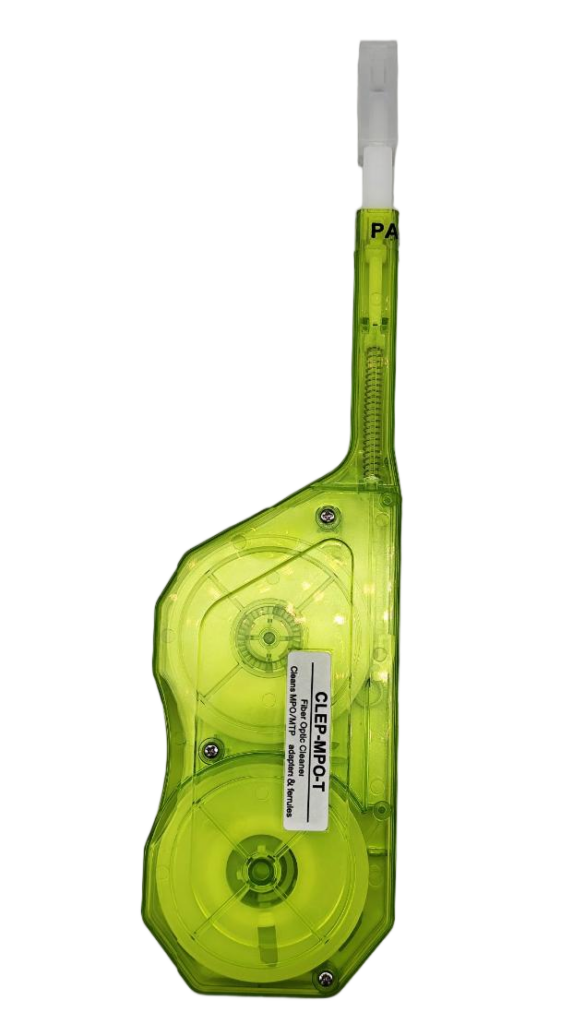
Different connector types require different cleaning methods. For example, LC connectors, MPO connectors, and transceiver interfaces may need specialized tools to fully remove contamination. To support these maintenance needs, TARLUZ offers a broad range of fiber cleaning tools, including one‑click cleaners, cleaning swabs, and lint‑free wipes, designed for efficient and reliable maintenance in AI data centers.
-
Effective cleaning performance: Each tool supports hundreds of cleaning cycles, meeting the demands of long‑term, high‑frequency maintenance.
-
Simple one‑push operation: A straightforward push‑and‑clean design makes cleaning fiber connector end faces fast and convenient.
-
Strong contaminant removal: These tools effectively remove dust, oil, and fine particles, helping maintain stable optical signal transmission.
-
Anti‑static protection: Anti‑static materials and design reduce particle adhesion, keeping connector end faces cleaner for longer.
-
Flexible for different scenarios: They work for both handheld cable assemblies and hard‑to‑reach end faces in tight spaces like patch panels.
-
Broad connector compatibility: Compatible with many mainstream fiber connector types, so one tool can handle diverse cleaning needs.
Follow a Cleaning Workflow
A clear cleaning workflow improves consistency and reduces mistakes. A common approach is the inspect‑clean‑inspect process: first inspect the connector, clean it with the appropriate tool if needed, then inspect it again before making the connection. This simple workflow helps prevent contaminated fibers from being plugged into active links and supports more reliable network operation.
Perform Regular Maintenance
Fiber cleaning should not be a one‑time action. In AI data centers, frequent moves, adds, and changes increase the chance of contamination over time. Regular maintenance—especially for high‑traffic links and critical interconnects—helps keep optical interfaces in good condition and lowers the risk of performance degradation.
Conclusion
Fiber contamination is not a minor maintenance issue in AI data centers. It directly affects link stability, data transmission efficiency, and even GPU utilization across the cluster. As networks move toward 400G and 800G, the cost of ignoring connector cleanliness becomes much higher. This makes fiber cleaning a practical and necessary part of daily operations, helping data centers reduce hidden risks and maintain consistent performance at scale.