

In optical transport networks (OTN), wavelength division multiplexing (WDM) systems primarily include two types: Coarse Wavelength Division Multiplexing (CWDM) and Dense Wavelength Division Multiplexing (DWDM). As two mainstream WDM technologies, both enhance fiber bandwidth utilization by simultaneously transmitting optical signals at different wavelengths within the same optical fiber. So, what exactly are the differences between CWDM and DWDM?
Overview of WDM, CWDM, and DWDM
Before making a comparison, we first need to understand the basic concepts of WDM, CWDM, and DWDM.
What is WDM?
WDM (Wavelength Division Multiplexing) is a technology used to transmit large volumes of data between sites. It increases network bandwidth by simultaneously transmitting multiple signals at different wavelengths within the same optical fiber. Therefore, WDM technology effectively improves optical fiber resource utilization and optimizes overall network investment.
What are CWDM and DWDM?
As mentioned above, both CWDM and DWDM are developed based on WDM technology, but they differ in wavelength schemes and application areas. CWDM (Coarse Wavelength Division Multiplexing) features a simple structure and flexible deployment, making it applicable to most types of fiber optic networks. It is typically deployed in point-to-point topologies within enterprise networks and telecommunications access networks. In contrast, DWDM (Dense Wavelength Division Multiplexing) is considered a solution for metropolitan area networks. Nowadays, it is commonly used in ring topologies for data center interconnection and financial service networks.
Applications
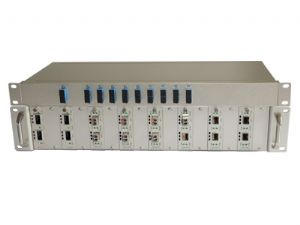
CWDM is widely used in cable television networks and optical modules, such as GBIC and SFP CWDM optical modules, providing standardized wavelengths for efficient data transmission. Passive CWDM, in particular, is suitable for FTTP (Fiber to the Premises), as it requires no power supply and relies solely on passive optical components for signal multiplexing. Overall, CWDM supports cost-effective transmission of data, video, and voice signals, and has developed alongside DWDM.
DWDM is extensively used in telecommunications and cable networks for long-distance, high-bandwidth, and security-sensitive applications. It plays a crucial role in core and metropolitan area networks by enhancing bandwidth and bridging computing distances. In high-throughput data centers, it enables service integration and supports geographically distributed architectures for data center interconnect (DCI).
CWDM vs DWDM: Comparison of Advantages and Disadvantages
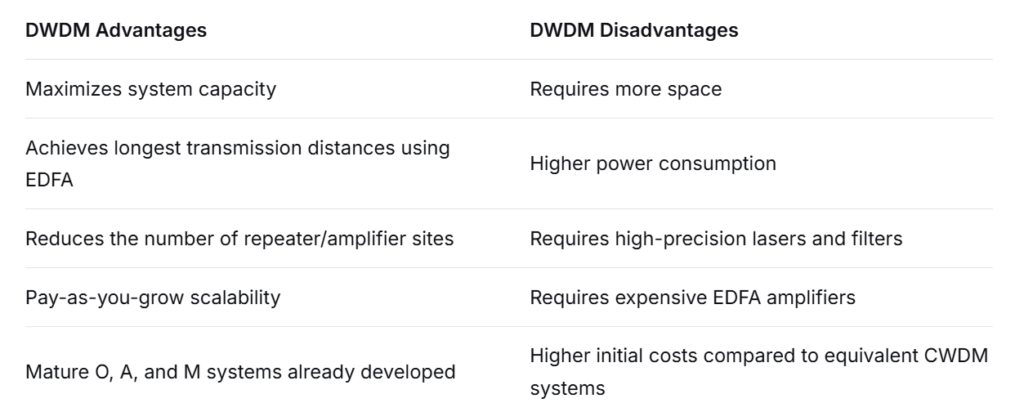
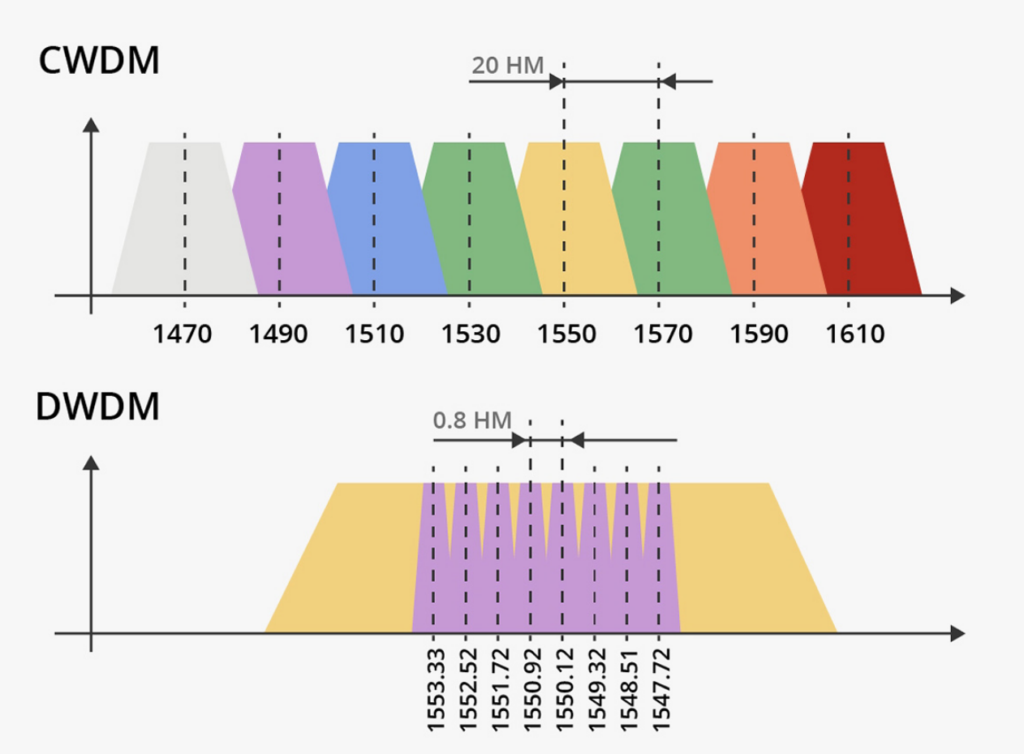
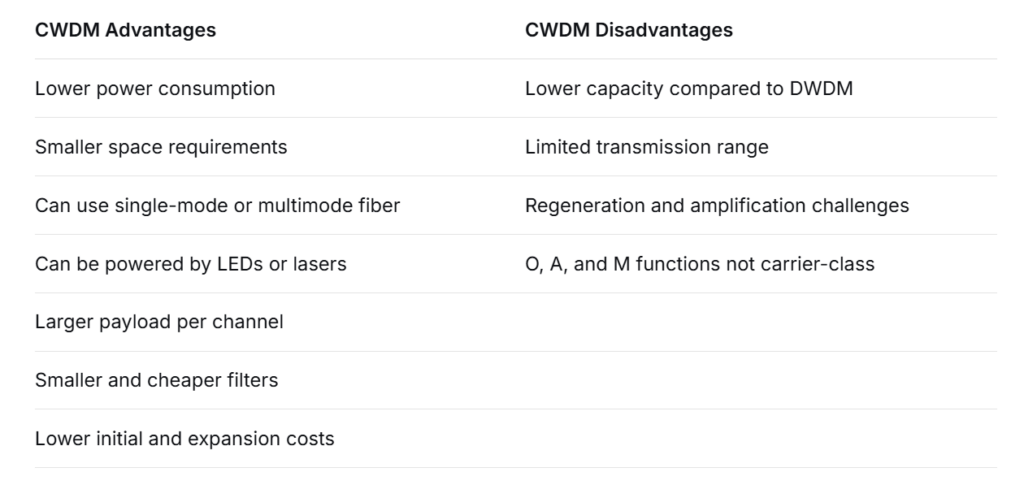
As noted above, the primary difference between DWDM and CWDM lies in channel spacing (CWDM’s channel spacing is nearly 100 times that of DWDM). This makes CWDM technology simpler, resulting in respective advantages and disadvantages for the two systems in terms of cost, performance, and other aspects.
CWDM
DWDM