

Optical Time Domain Reflectometers (OTDRs) are essential instruments for evaluating the integrity and performance of fiber optic networks. They provide a detailed visual representation—known as a trace—of a cable’s condition, helping technicians verify installations, locate faults, and monitor changes over time. However, incorrect interpretation of OTDR results can lead to significant operational losses, including wasted resources and costly errors. It is estimated that misinterpretations cost contractors up to $100,000 annually, underscoring the need for proper understanding and analysis.
How an OTDR Works
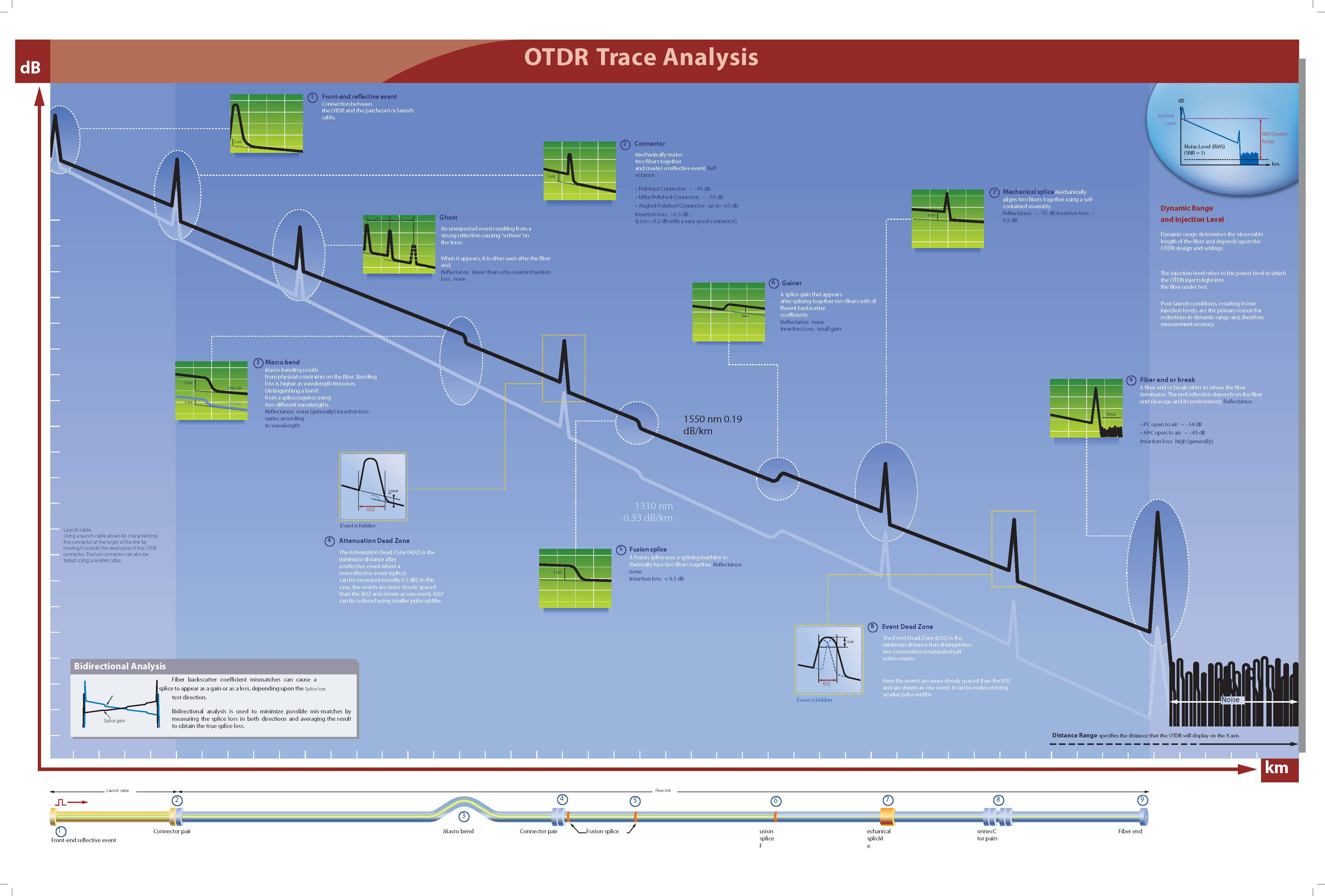
An OTDR operates similarly to radar, sending calibrated light pulses into an optical fiber and analyzing the reflected signals. The resulting trace displays key characteristics such as splices, connectors, bends, and breaks. Two primary types of reflections are measured:
-
Reflectance: Caused by polished fiber ends or faults, these appear as distinct peaks on the trace.
-
Backscatter: Generated by light scattering due to impurities in the fiber, backscatter produces a continuous signal that indicates attenuation along the cable.
The vertical axis of an OTDR trace shows optical loss in decibels (dB), while the horizontal axis represents distance. By calculating the time delay of returning light, the OTDR converts time into distance and loss values, creating a comprehensive profile of the fiber link.
Reading an OTDR Trace
To accurately interpret a trace, begin by configuring the OTDR with appropriate settings for fiber length, pulse width, and acquisition time. The trace will then display “events”—points of interest such as connectors or splices—each characterized by a loss value and, in reflective cases, a peak.
The slope of the trace indicates the fiber’s attenuation coefficient, measured in dB/km. A consistent downward slope represents normal signal loss over distance, while abrupt changes often signify events requiring attention.
Key Performance Benchmarks
When reviewing OTDR results, compare measurements against industry standards:
-
Splice Loss: <0.05 dB for single-mode fibers
-
Mated Connector Loss: <0.5 dB for single-mode fibers
-
Reflectance: >-40 dB for single-mode fibers
-
Attenuation: Approximately 0.40 dB/km at 1310 nm and 0.25 dB/km at 1550 nm for single-mode fibers
Measuring Loss and Reflectance
To measure splice or connector loss, position one marker just before the event’s reflective peak and a second marker just after it. The OTDR will compute the loss between them. For reflectance, place the first marker before the peak and the second at its peak. Ensure markers are not placed on curved sections of the trace to avoid inaccuracies.
Identifying Troublesome Events
Certain events can complicate trace analysis. Recognizing these can prevent misinterpretation:
-
Ghosts: Caused by strong reflections in short fibers, ghosts appear as repeated trace patterns without associated loss. They are often found at consistent distances from highly reflective events.
-
Nonreflective Breaks: Occur when a fiber is shattered or exposed to liquids, preventing light from reflecting back. These can be challenging to detect due to the absence of a peak.
-
Gainers: Appear as a gain in signal at a splice point, often due to mismatched fiber cores with different backscatter coefficients. Though no actual gain occurs, the trace may misleadingly suggest one.
Conclusion
OTDRs are powerful diagnostic tools that, when used correctly, provide invaluable insights into fiber network health. Proper training and careful analysis are essential to avoid costly errors and ensure reliable communication infrastructure. For further guidance on OTDR selection and application, consult experienced professionals in fiber optic testing and equipment.