

With the continuous advancement of optical fiber sensing and transmission technology, we are increasingly facing extreme application scenarios: the blazing core of jet engines, cryogenic environments as low as -269°C, highly corrosive chemical storage tanks… In these environments, ordinary optical fibers are fragile. When the temperature exceeds the critical point of 400°C, conventional organic coatings—whether nylon, polyimide, acrylic, or Teflon—rapidly undergo thermal oxidative aging and lose their protective function, directly leading to signal transmission failure. How can optical fibers work stably in such harsh conditions? The answer lies in gold-plated optical fiber.
What is Gold-Plated Optical Fiber?
Gold-plated optical fiber, also known as gold-coated fiber or gold-plated high-temperature fiber, belongs to the category of metal-coated optical fibers. It uses a dense layer of metallic gold as a protective coating on the fiber surface, replacing traditional organic coatings. This “golden armor” endows the fiber with unprecedented environmental adaptability, allowing it to operate stably over a wide temperature range from -269°C to +700°C.

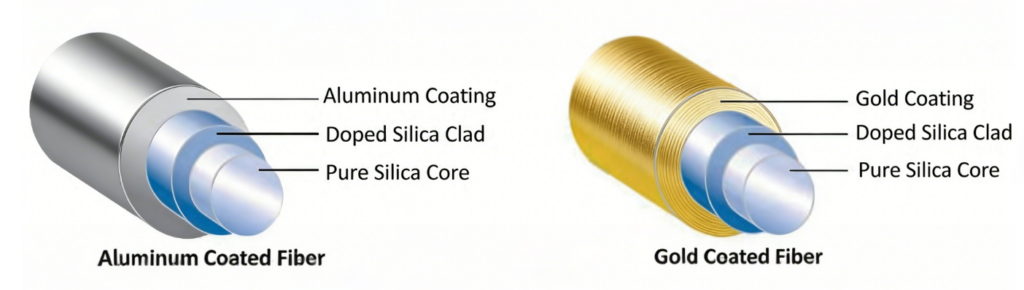
Performance Advantages
Compared with organic-coated optical fibers, gold-plated optical fibers offer three major advantages:
Extreme temperature resistance: They can not only withstand high-temperature oxidizing environments above 400°C, but also maintain stable performance at cryogenic temperatures close to absolute zero, making them one of the most temperature-resistant optical fibers available.
Excellent corrosion resistance: Gold is one of the most chemically stable metals. The gold coating effectively isolates external moisture acid gases, and various corrosive chemicals, ensuring long-term reliable operation of the fiber in harsh chemical environments.
Unique solderability: This is a unique processing advantage of gold-plated optical fibers. Traditional organic-coated fibers cannot be soldered, but the surface of gold-plated fibers has good solderability. This characteristic allows the fiber to be easily hermetically connected to metal components, greatly simplifying the packaging process of optoelectronic devices and improving connection reliability and airtightness.
Typical Applications
Thanks to the outstanding properties mentioned above, gold-plated optical fibers have become the ideal choice for many high-tech fields:
- High-Temperature Sensing and Monitoring
In aerospace and energy sectors, gold-plated optical fibers are widely used for internal temperature and strain monitoring of rocket engines, turbine engines, and jet engines, providing real-time operational feedback. Meanwhile, in oil and gas extraction, they can withstand high-temperature and high-pressure downhole environments for distributed temperature sensing, helping to improve recovery efficiency and safety.
- Cryogenic and Superconducting Fields
In cryogenic physics and superconducting facilities, traditional fiber coatings tend to become brittle and crack. Gold-plated optical fibers, with their excellent low-temperature toughness, are widely used as cryogenic fibers and low-temperature-resistant fibers for temperature measurement and data transmission in superconducting magnets, particle accelerators, and space exploration equipment.
- Corrosive Environments and Special Industries
In chemical and nuclear industries, gold-plated optical fibers are suitable for strong corrosive environments such as chemical storage tanks and electrolytic cells, serving as corrosion-resistant fibers for long-term stable operation. Meanwhile, in nuclear facilities and high-energy physics experiments, the gold coating provides some radiation protection, effectively extending the service life of radiation-resistant sensors.
- Ultra-High Vacuum and Hermetic Sealing
Taking advantage of the solderability of gold-plated optical fibers, it is possible to achieve ultra-high vacuum sealing for optical fiber feedthroughs in vacuum chambers. This has irreplaceable value in applications with extremely high vacuum requirements, such as semiconductor manufacturing equipment and surface science analytical instruments.