

In modern data centers—especially in AI and 400G/800G environments—fiber cabling is no longer just about connectivity. Choosing the wrong MTP®/MPO cable can lead to link failures, wasted fibers, and costly rework. This guide focuses specifically on MTP®/MPO-12 cables, explaining their matching logic with various transceivers and providing clear selection recommendations.
1. Core Matching Rule
The relationship between an MTP®/MPO cable and a transceiver is determined by the number of optical lanes. Each transceiver uses multiple transmit (Tx) and receive (Rx) lanes, and each lane requires one pair of fibers (one Tx, one Rx). Therefore, the total fiber count needed = number of lanes × 2.
-
4‑lane modules (e.g., SR4, DR4) → require 8 fibers
-
8‑lane modules (e.g., SR8, DR8) → require 16 fibers
-
10‑lane modules (e.g., SR10) → require 20 fibers
An MTP®/MPO‑12 connector has 12 fiber positions, but for typical 4‑lane applications, only 8 of the 12 fibers are used (usually positions 1–4 and 9–12), leaving 4 fibers unused. This makes MTP‑12 the dominant choice for 4‑lane transceivers from 40G to 400G. For 8‑lane modules, you can use dual MTP‑12 interfaces (2×12) in parallel, providing 16 active fibers.
2. Transceivers Compatible with MTP®/MPO‑12 Cables
The table below lists common transceiver types that work with MTP‑12 cables, covering multimode (OM3/OM4) and single‑mode (OS2) options, as well as single‑port and dual‑port configurations.
| Data Rate | Transceiver Type (Lane Count) | Fiber Type | Fiber Count | Connector | Polish | Max. Distance |
|---|---|---|---|---|---|---|
| 40G | SR4 (4‑lane, MM) | OM4/OM3 | 12 | MTP®/MPO‑12 | UPC | OM4: 150m / OM3: 100m |
| 40G | PLR4 (4‑lane, SM) | OS2 | 12 | MTP®/MPO‑12 | APC | 10 km |
| 100G | SR4 (4‑lane, MM) | OM4/OM3 | 12 | MTP®/MPO‑12 | UPC | OM4: 100m / OM3: 70m |
| 100G | PSM4 (4‑lane, SM) | OS2 | 12 | MTP®/MPO‑12 | APC | 500m |
| 200G | SR4 (4‑lane, MM) | OM4/OM3 | 12 | MTP®/MPO‑12 | UPC | OM4: 100m / OM3: 70m |
| 400G | SR4.2 (4‑lane, MM, dual‑wavelength) | OM4/OM3 | 12 | MTP®/MPO‑12 | UPC | OM4: 150m / OM3: 70m |
| 400G | SR4 (4‑lane, MM) | OM4/OM3 | 12 | MTP®/MPO‑12 | APC | OM4: 50m / OM3: 30m |
| 400G | DR4 (4‑lane, SM) | OS2 | 12 | MTP®/MPO‑12 | APC | 500m |
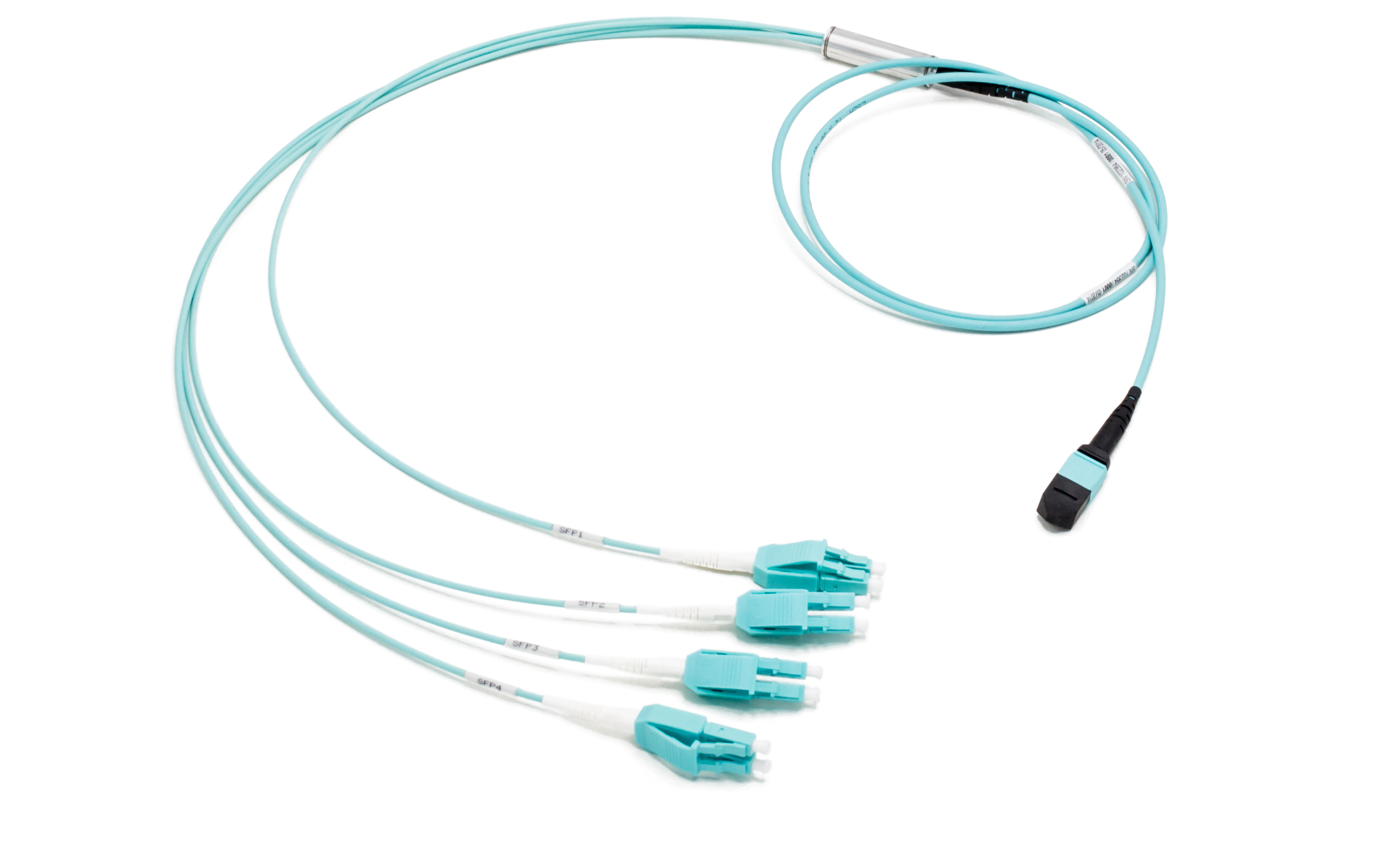
| 800G | SR8 (8‑lane, MM) – dual‑port | OM4/OM3 | 2×12 | Dual MTP®/MPO‑12 | APC | OM4: 50m / OM3: 30m |
| 800G | DR8 (8‑lane, SM) – dual‑port | OS2 | 2×12 | Dual MTP®/MPO‑12 | APC | 500m |
Note: “Fiber Count = 12” means a single MTP‑12 connector; “2×12” means two MTP‑12 interfaces are used together to provide 16 active fibers for 8‑lane modules.
3. Selection Guidelines by Use Case
3.1 Standard 4‑Lane Applications (40G – 400G)
-
Typical modules: SR4, DR4, PSM4, SR4.2
-
Connection: Single MTP‑12 cable – only 8 of the 12 fibers are active (the remaining 4 are unused).
-
Use cases: Traditional data center 40G/100G backbones, 400G short‑reach multimode or single‑mode links.
-
Consideration: If you want 100% fiber utilization, you could use MTP‑8 cables (fully compatible with these modules), but MTP‑12 remains the mainstream choice due to its widespread deployment in structured cabling.
3.2 8‑Lane Applications (800G and beyond)
-
Typical modules: SR8, DR8
-
Connection: Requires two MTP‑12 ports – each port provides 8 active fibers (again, 4 unused per port), totaling 16 fibers for 8‑lane Tx/Rx.
-
Use cases: AI clusters, hyperscale back‑end networks, 800G backbone links.
-
Alternative: You may use a single MTP‑16 cable (16 fibers in one connector) for new installations, but dual MTP‑12 is a practical upgrade path if you already have MTP‑12 infrastructure.
3.3 Special Case – 100G CFP SR10 (10 lanes)
-
Some older 100G modules (e.g., CFP SR10) use 10 lanes (20 fibers). MTP‑12 cannot support this; you will need MTP‑24 cables. MTP‑12 is not applicable for such modules.
4. Summary Reference
| Your Module Lane Count | Recommended MTP‑12 Configuration | Typical Speeds |
|---|---|---|
| 4‑lane (SR4/DR4) | Single MTP‑12 | 40G, 100G, 200G, 400G |
| 8‑lane (SR8/DR8) | Two MTP‑12 (dual‑port) | 800G, 1.6T |
| 10‑lane (SR10) | Not supported – use MTP‑24 | 100G (legacy) |
MTP®/MPO‑12 remains an economical and widely available choice for 4‑lane modules, thanks to its extensive legacy deployment. For new 800G builds, MTP‑16 offers higher fiber efficiency, but dual‑port MTP‑12 is a perfectly reliable solution if you need backward compatibility with existing MTP‑12 patch panels.
Key takeaway: Always match the cable to the lane count and interface definition of your transceiver. Verify fiber count, connector type, and polish – and you’ll avoid most deployment pitfalls.