

This article outlines the key characteristics and applications of multimode fiber grades, ranging from OM1 to OM5.
From OM2 onward, the core size remains consistent at 50 µm. OM3 fiber supports 10 GbE transmission over distances of up to 300 meters. While it can also accommodate 40 and 100 GbE across 100 meters, its most common application remains 10 GbE. With a bandwidth of 2000 MHz·km and an aqua-colored jacket, OM3 is optimized for laser-based equipment using VCSEL light sources. It is widely adopted in modern data centers due to its capability for high-speed data transmission.
OM4, OM5, and SWDM Technology
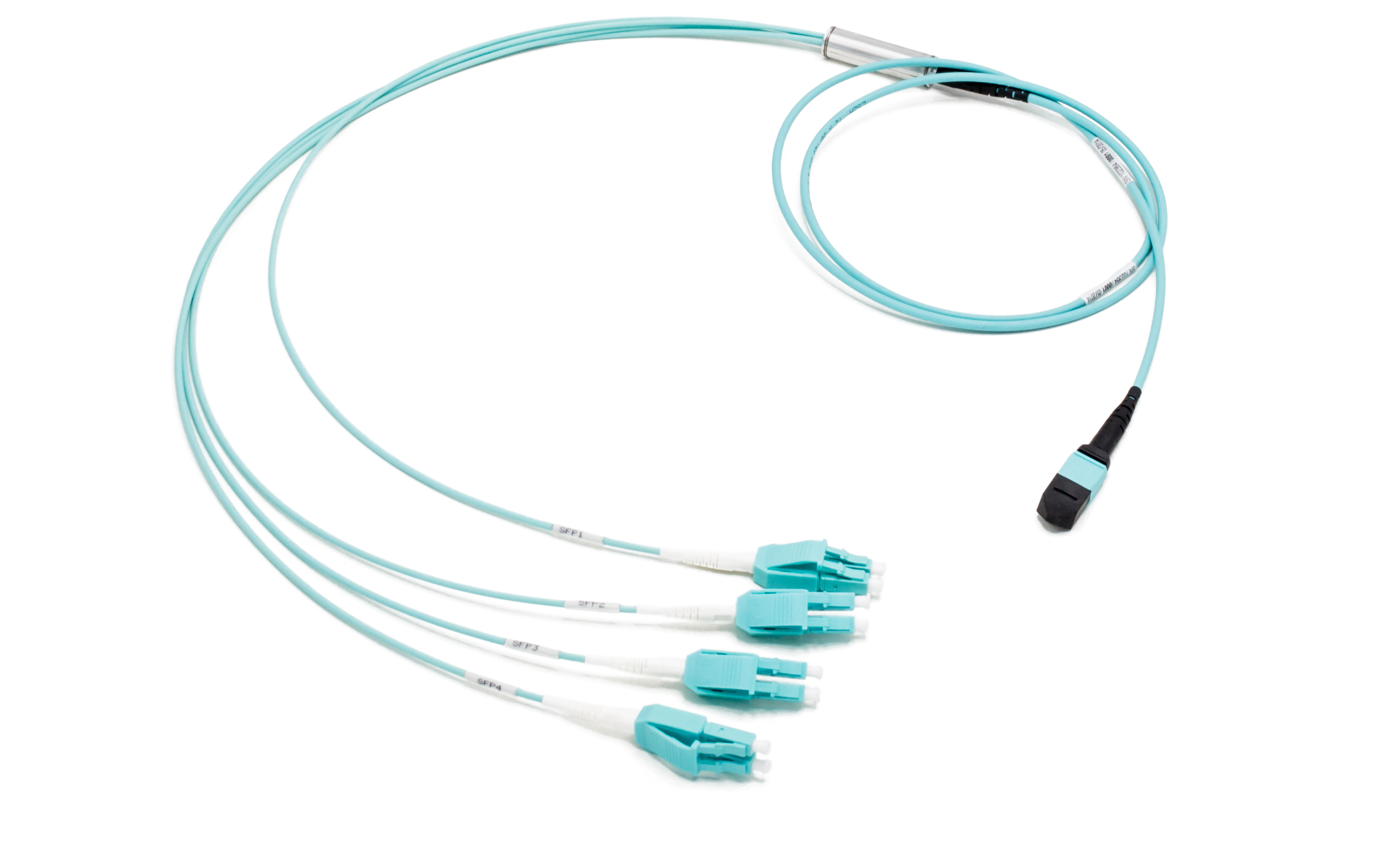
OM4 shares the same aqua jacket color as OM3 and maintains full backward compatibility with it. Designed specifically for VCSEL transmission, OM4 extends the reach for 10 GbE to 550 meters—250 meters farther than OM3—and can support 40 and 100 GbE over distances up to 150 meters. Its higher bandwidth of 4700 MHz·km makes it suitable for environments requiring high bandwidth and low latency, such as high-performance computing, data centers, and enterprise networks.
OM5, the latest multimode fiber grade, features a lime green jacket and is backward compatible with OM4. Also referred to as wideband multimode fiber (WBMMF), it is engineered to support at least four wavelength division multiplexing (WDM) channels within the 850–953 nm range, each operating at a minimum speed of 28 Gbps. OM5 can support 100 GbE over 150 meters and offers a substantial bandwidth of 28,000 MHz·km.
OM5 is designed to work with shortwave wavelength division multiplexing (SWDM) technology, enabling multiple wavelengths to be transmitted over a single fiber. This makes it an ideal choice for future-proofing networks as data rates increase, as well as for high-density data centers seeking to maximize bandwidth without deploying additional fibers.
SWDM is a technology used to enhance the data capacity of multimode fibers by transmitting multiple signals at different wavelengths over the same fiber. It is optimized for use with OM4 and OM5 fibers, enabling higher data rates over longer distances without requiring more fiber strands. In contrast, conventional dense wavelength division multiplexing (DWDM) is typically used with single-mode fibers, while SWDM is tailored for multimode fibers—especially OM5, which delivers superior performance at short wavelengths.
SWDM is primarily deployed in high-speed network settings such as data centers, enterprise networks, and telecommunications infrastructure, where both high bandwidth and efficient fiber utilization are essential.
Present Applications of OM3 to OM5 Fibers
In high-density environments like data centers, OM3, OM4, and OM5 fibers are commonly used to support multiple 10/40/100 GbE connections, delivering optimized performance and reduced latency. Many organizations are upgrading to OM4 and OM5 to ensure their networks can accommodate rising data traffic, particularly in light of growing cloud computing and virtualization demands.