


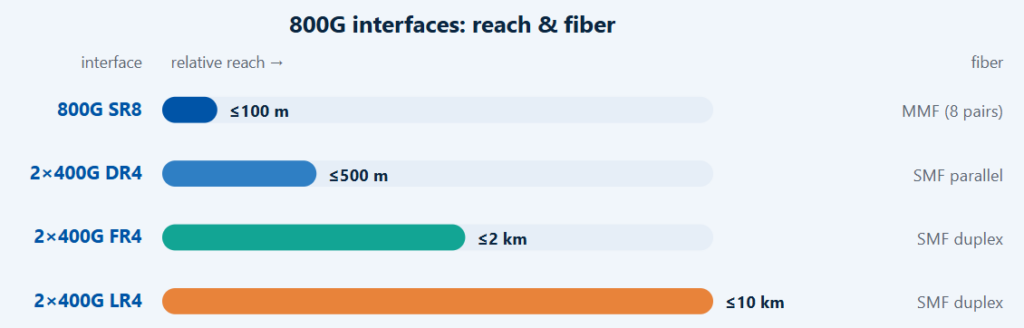
All 800G optics use eight 100G PAM4 lanes, but the media interface dictates deployment. Reach, fiber type, and connector style separate the four variants more than raw bandwidth. The «2x» prefix on DR4, FR4, and LR4 denotes a dual-400G structure that runs as one 800G port or breaks out into two independent 400G links.
The Four 800G Reach Classes at a Glance
| Variant | Reach | Fiber | Wavelength Plan | Connector | Native Breakout |
|---|---|---|---|---|---|
| 800G-SR8 | 100 m | Multimode (OM4) | 8x 850 nm, parallel | MPO-16 | 2x400G-SR4 or 8x100G-SR |
| 800G-2xDR4 | 500 m | Single-mode | 8x 1310 nm, parallel | MPO-16 or dual MPO-8/12 | 2x400G-DR4 |
| 800G-2xFR4 | 2 km | Single-mode | 2x CWDM4 (4 wavelengths each) | Dual duplex LC | 2x400G-FR4 |
| 800G-2xLR4 | 10 km | Single-mode | 2x LWDM/CWDM4 (4 wavelengths each) | Dual duplex LC | 2x400G-LR4 |
MMF vs. SMF: The First Fork
The primary decision is whether the run stays in a rack row or spans a data hall.
-
Choose MMF (SR8) for links under ~100 m (top-of-rack to leaf). It uses 850 nm VCSEL-based parallel optics and pairs naturally with MPO trunks. It is economical for short, dense links but limited by modal dispersion.
-
Choose SMF (DR/FR/LR) for runs leaving the rack row, crossing halls, or connecting buildings. SMF uses 1310 nm-region lasers with no modal dispersion, supporting 500 m, 2 km, and 10 km by simply changing the optic. Standardizing on SMF future-proofs cabling for 400G, 800G, and 1.6T.
Cost Trade-off: Multimode optics are cheaper per module, but OM4 trunks cost more per meter/fiber. Parallel optics (SR8, 2xDR4) consume 16 fibers per 800G port, compounding fiber costs on longer runs. WDM optics (2xFR4, 2xLR4) collapse the fiber count to four, flipping the economics in favor of single-mode WDM as distance grows.
Variant Breakdown
800G-SR8: 100 m over Multimode
Carries eight 100G lanes over eight fiber pairs at 850 nm. Terminates on a 16-fiber MPO. Ideal for short, dense intra-pod links, breaking out cleanly into 2x400G-SR4 or 8x100G-SR.
800G-2xDR4/DR8: 500 m Parallel Single-Mode
Uses eight 1310 nm lanes as two DR4 groups of four, reaching 500 m on SMF. The workhorse for spine-leaf links inside a data hall where SMF is deployed but WDM isn’t required. Terminates on MPO (16-fiber for full 800G, or split to two 8-fiber groups) and breaks out to 2x400G-DR4, bridging 800G spines to 400G access layers.
800G-2xFR4: 2 km over Duplex Single-Mode
Replaces parallel fiber with WDM. Each 400G half is a CWDM4-style FR4 multiplexing four wavelengths onto a single fiber pair. It uses only four fibers total (two duplex LC pairs), lowering structured-cabling costs on longer runs. The right pick for cross-hall aggregation and campus links up to 2 km with existing FR4 infrastructure. Breaks out to 2x400G-FR4.
800G-2xLR4: 10 km over Duplex Single-Mode
Extends the duplex-LC, WDM approach to 10 km using higher-power lasers. Targets DCI within a metro campus, building-to-building links, and runs beyond FR4’s 2 km ceiling. Uses two duplex LC pairs and breaks out into 2x400G-LR4. For links beyond 10 km, coherent 800G ZR/ZR+ becomes relevant.
MPO vs. Duplex LC and Breakout Design
-
Parallel optics (SR8, 2xDR4) spread lanes across many fibers using MPO connectors. More fibers mean higher trunk cost, but breakout to 400G or 100G is physically simple with MPO harnesses.
-
WDM optics (2xFR4, 2xLR4) combine lanes onto one fiber pair per 400G, using standard duplex LC. Fewer fibers cut cabling costs over distance, but the WDM optics carry a mux/demux complexity premium.
Polarity and Polish: MPO plants must maintain consistent Method A/B/C polarity. Single-mode MPO uses APC polish; multimode MPO uses UPC. Mixing polish types or losing polarity causes dark links. For duplex LC WDM, use standard LC/UPC or LC/APC patch cords matched to the trunk and verify insertion-loss budgets near the 2 km and 10 km limits.
2x400G Breakout: The 2xDR4, 2xFR4, and 2xLR4 modules are built as two 400G engines, allowing one 800G port to serve two 400G leaf/NIC ports. The far-end partner must match reach and connector. Before committing, verify the switch ASIC and NOS support 2x400G channelized mode, and ensure cabling routes each 400G group correctly.
Quick Selection Summary
-
Under 100 m, multimode plant, max density: 800G-SR8
-
Up to 500 m, single-mode, no WDM, MPO cabling: 800G-2xDR4
-
Up to 2 km, duplex LC, low fiber count: 800G-2xFR4
-
Up to 10 km, campus/DCI reach: 800G-2xLR4
Related Posts
- 800G Connection Solution - Point-to-Point Connection Using LC Duplex to LC Duplex
Point-to-point cabling solutions are typically used in rack-level interconnection scenarios. They are designed to meet the direct interconnection needs of devices within the same physical rack. However, this architecture has spatial limitations. When devices are dispersed across different functional areas of a data center or are geographically distant from each…
 What do the suffixes “SR8, DR4, xDR4 FR4 and 2FR4” stand for OSFP Modules?
The letters are reach specifications, and the number refers to the number of optical channels: Description Connector Type SR8: “SR” refers to 100m reach using multi-mode fiber, and “8” implies there are 8 optical channels. Each of the 8 optical channels from an SR8 module are carried on separate fibers,…
- 400G QSFP-DD portfolio
Standard Description Optical Connector QSFP-DD-400-CUxM 400G QSFP-DD to QSFP-DD Passive Copper Cable, up to 3 meters N/A QSFP-DD-400-AOCxM 400G QSFP-DD Active Optical Cable, from 1meter to 30 meters N/A QSFP-DD-4X100-SR8 400G QSFP-DD Transceivers, 400GBASE-SR8, 100m over OM4 MMF MPO-16/APC QSFP-DD-4X100G-FR QSFP-DD Transceiver, 4x 100GBASE-FR, 2km parallel SMF MPO-12 QSFP-DD-4X100G-LR QSFP-DD…
 Overview of optics options for 800GbE
The growing demand for bandwidth in the Cloud, Artificial Intelligence, Machine Learning, etc, and future hyper-scale data centers drive the demand for 800GE Optics. Market researchers consider that 400G will hold sway until 2023 and that 800G will come into its own as of 2025. This article is introducing the…
 FAQ of 800G Transceivers
1. What form-factors are used for 800G transceivers? There are two main form-factors for 800G transceivers now, the OSFP and the QSFP-DD: OSFP Form Factor: OSFP is an abbreviation of Octal Small Form-factor Pluggable. This transceiver with Octal (8) electrical lanes, with each lane modulated at 100Gb/s to reach a…