

Upgrading to a fiber‑based network seems straightforward until you consider the existing infrastructure. Many enterprise environments still rely on copper cabling and thousands of Ethernet‑connected devices that cannot be replaced overnight. As organisations seek to increase bandwidth and support future growth, Fiber to the Desk (FTTD) has emerged as a practical path forward.
Why FTTD Is Gaining Traction
Compared with traditional copper LAN architectures, FTTD offers several clear advantages:
-
Longer transmission distances
-
Higher bandwidth scalability
-
Superior resistance to electromagnetic interference (EMI)
-
Improved network stability
-
Lower signal loss over long runs
Conventional Ethernet cabling is generally limited to 100 metres, which can become a constraint in large offices, campuses, hotels, and smart buildings. Fibre optic infrastructure, however, supports transmission over several kilometres while providing ample bandwidth headroom for future network expansion.
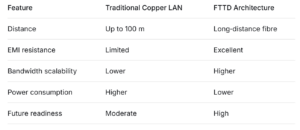
With these benefits, FTTD is becoming a practical choice for enterprises building next‑generation networks.
The Deployment Challenge in FTTD
While FTTD delivers significant advantages in bandwidth, distance, and long‑term scalability, it introduces a practical hurdle. Most endpoint devices in enterprise environments—desktop computers, IP phones, network printers, wireless access points, and access control systems—still rely on standard RJ45 Ethernet interfaces rather than fibre connections.
Replacing these devices with fibre‑native alternatives is technically possible, but it often inflates project costs, increases deployment complexity, and extends implementation timelines. In many cases, existing equipment remains fully functional and meets operational requirements, making wholesale replacement difficult to justify.
Consequently, many organisations adopt a phased migration approach: they upgrade the network backbone to fibre while retaining their current Ethernet‑based endpoints. This creates a need for a simple, cost‑effective way to bridge fibre infrastructure and copper‑connected devices without disrupting daily operations.
How Media Converters Enable FTTD Deployments
A media converter for FTTD solves this challenge by translating optical fibre signals into Ethernet signals, allowing existing copper devices to operate seamlessly within a fibre‑based network environment.
In a typical FTTD deployment, the network structure extends fibre directly to the desk area, with a media converter placed at each endpoint to interface with the user’s device. By using fibre‑to‑copper media converters, enterprises can extend fibre connections to desktop areas without replacing all existing Ethernet equipment. This significantly reduces upgrade costs while simplifying the migration from traditional copper networks to fibre infrastructure.
Key benefits of using Ethernet media converters in FTTD deployments include:
Flexible Fibre‑to‑Copper Integration
Media converters allow organisations to gradually migrate from copper to fibre without replacing all endpoint devices at once. This lowers upfront investment and reduces deployment complexity.
Extended Network Reach
Traditional Ethernet links are limited to 100 metres. With fibre connections and media converters, network transmission can span several kilometres while maintaining stable performance—ideal for campus environments or multi‑building facilities.
Enhanced EMI Immunity
Fibre optic cabling is immune to electromagnetic interference, making FTTD particularly valuable in industrial offices, healthcare facilities, data centres, and environments with dense electrical equipment.
Simplified Deployment
Plug‑and‑play media converters streamline network expansion and accelerate deployment in both new construction projects and retrofit upgrades. Their compact form factor and minimal configuration requirements reduce installation time and operational overhead.
Selecting the Right Media Converter for FTTD
When planning an FTTD deployment, organisations typically evaluate media converters based on factors such as transmission distance, management capabilities, and power delivery needs.
-
For standard desktop connectivity, basic copper‑to‑fibre media converters provide reliable Gigabit performance with simple plug‑and‑play operation.
-
For networks requiring greater visibility and control, managed media converters offer remote monitoring, link diagnostics, and easier troubleshooting.
-
For deployments involving wireless access points, IP cameras, or VoIP phones, Power over Ethernet (PoE)‑enabled media converters are essential to deliver both data and power over the same copper cable.
Modern media converter solutions support flexible SFP connectivity, allowing administrators to choose the appropriate optical transceiver for the required fibre type (single‑mode or multi‑mode) and distance. They also accommodate various speed grades—from Gigabit to 10G—to match current bandwidth needs while leaving room for future upgrades.
Conclusion
Media converters play a vital role in making FTTD deployments practical, cost‑effective, and minimally disruptive. By bridging fibre backbones with existing Ethernet devices, they help organisations modernise their infrastructure without extensive equipment replacement. This phased approach not only protects existing investments but also lays a solid foundation for future network growth—delivering the long‑reach, high‑bandwidth, and EMI‑immune performance that modern enterprises demand.
Whether you are retrofitting an older building or planning a new campus network, media converters offer a proven, flexible tool to bring fibre to the desk at your own pace, ensuring a smooth transition toward a fully fibre‑ready future.