

Long-Distance Transmission Capability
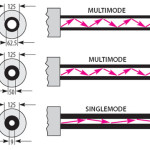
In modern large-scale data centers, the physical distance between network devices such as servers and switches can be considerable. Single-mode fiber (SMF), with its small core diameter of approximately 9 μm, effectively reduces signal attenuation, making it well-suited for long-distance transmission.
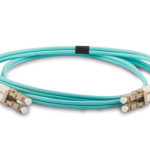
For instance, when OS2 single-mode fiber is used with SFP+ optical modules and LC duplex connectors, transmission distances can reach up to 10 km. In contrast, multimode fiber is more suitable for short-distance communication.
Smaller Bending Radius
Single-mode fiber cables feature a smaller bending radius, which makes them particularly suitable for scenarios requiring tight bends or installation in spaces with spatial constraints. According to the G.652.D standard, traditional single-mode fiber has a bending radius of 30 mm. In comparison, the latest OS2 fiber, compliant with the G.657.A1 standard, reduces the bending radius to 10 mm—just one-third of the G.652 standard. This significantly enhances adaptability in space-constrained environments, especially in areas with high cable density within data centers.
Extended Service Life
A key advantage of single-mode fiber lies in its long service life, which greatly reduces the need for frequent upgrades. For example, OS2 single-mode fiber deployed a decade ago can still support emerging technologies such as 100GBASE-DR over 500 m transmission distances. In contrast, traditional multimode fibers (e.g., OM1/OM2) can no longer meet the requirements of modern 100G networks. Furthermore, single-mode fiber offers a higher channel insertion loss budget (3–4 dB), significantly exceeding the 1.9 dB budget of multimode fiber. This allows for more fiber adapters within a link, providing greater flexibility in data center network design. These characteristics make single-mode fiber a future-ready and highly adaptable choice.
Lower Signal Loss
Single-mode fiber exhibits lower signal attenuation, helping to preserve data transmission quality and ensure stable and reliable communication. Due to its smaller core diameter, optical signals propagate in a more focused manner, reducing modal interference commonly seen in multimode fiber. As a result, data transmitted over single-mode fiber is more stable, reliable, and less susceptible to interference or eavesdropping.
Technological Support for Single-Mode Fiber
Both now and in the future, the advancement of high-speed network technologies is closely tied to the performance of single-mode fiber. For instance, 800G commercial optical modules are already available in single-mode versions, highlighting the critical role of single-mode fiber in supporting long-distance, high-bandwidth transmission. The low attenuation of single-mode fiber over long distances underpins these technological breakthroughs. Looking ahead, with the recent emergence of 1.6T DAC, single-mode connectivity will continue to evolve, paving the way for higher-speed, more scalable networks and helping data centers confidently address future challenges.
Factors to Consider in Data Center Cabling
Scalability: As data volumes continue to grow, planning for future expansion is essential. By designing a scalable cabling system, data center fiber infrastructure can easily accommodate future growth without disrupting existing operations. Single-mode fiber offers strong scalability, enabling higher data rates over long distances.
Security: For enterprises that rely on continuous data availability, data center security is of paramount importance. Security requirements must be carefully considered when designing cabling systems. Compared with multimode fiber, the smaller core diameter of single-mode fiber makes it significantly more difficult for potential eavesdroppers to intercept transmitted data, thereby providing a higher level of security.