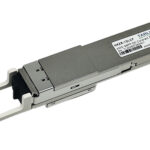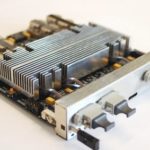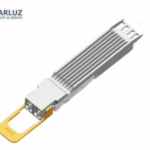


A QSFP (Quad Small Form‑factor Pluggable) module is a compact, hot‑pluggable optical transceiver used to connect switches, routers, servers, and storage systems over fiber optic links. The „Quad“ in its name refers to the four independent transmit and receive channels integrated within the module. Unlike SFP modules, which carry only a single channel, QSFP modules can send and receive four lanes simultaneously, dramatically increasing bandwidth density without requiring additional port counts.
What Does QSFP Stand For?
-
Quad – Four transmit and four receive lanes operating concurrently.
-
Small – The module occupies roughly the same panel footprint as a traditional SFP port, though it is slightly deeper.
-
Form‑factor – The physical dimensions, electrical pinout, and thermal envelope are all standardized.
-
Pluggable – The module inserts into a cage and can be replaced without tools or system downtime.
This combination enables a 1U switch to deliver dozens of 100G or 400G ports within a single chassis.
How Does a QSFP Module Work?
Inside a QSFP optical module, electrical signals from the switch ASIC arrive via a high‑speed edge connector. Laser drivers convert these electrical signals into optical signals for transmission. On the receive side, photodiodes detect the incoming light, and transimpedance amplifiers (TIAs) convert it back to electrical form.
A Digital Signal Processor (DSP) is often integrated to perform signal equalization, retiming, clock recovery, and PAM4 processing. Forward Error Correction (FEC) is typically handled by the host ASIC or NIC, though some advanced optical modules may also participate in FEC‑related functions.
NRZ vs. PAM4: The Evolution
Early‑generation QSFP modules used Non‑Return‑to‑Zero (NRZ) signaling, which encodes one bit per symbol. As lane rates pushed beyond 25 Gbps, signal‑integrity constraints drove the industry toward PAM4 (4‑level Pulse Amplitude Modulation), which encodes two bits per symbol. PAM4 doubles throughput at the same baud rate, but requires stronger FEC and tighter signal‑to‑noise ratio (SNR) margins.
Understanding this shift explains why newer QSFP56, QSFP112, and QSFP‑DD modules place higher demands on host platforms compared to older QSFP+ variants.
Key Takeaways
| Aspect | Description |
|---|---|
| Port Density | Four channels per module, significantly increasing bandwidth per rack unit. |
| Hot‑Pluggable | Tool‑free insertion and removal, enabling field‑replaceable upgrades without service interruption. |
| Signal Encoding | Transitioned from NRZ to PAM4 to support higher data rates (400G and beyond). |
| DSP Integration | Enables advanced equalization and signal conditioning for robust link performance. |