


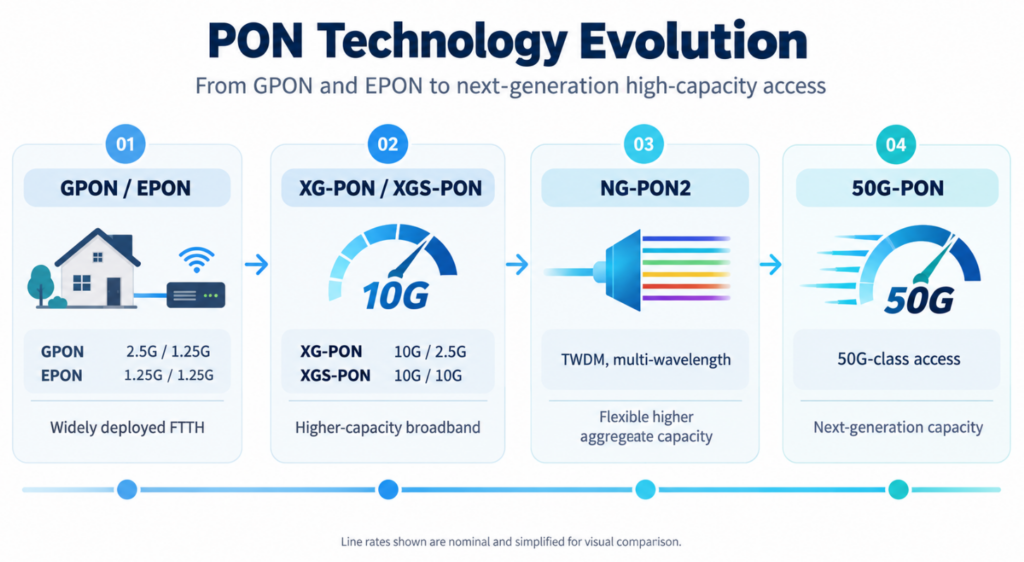
XPON (Passive Optical Network) is an umbrella term for a class of fiber access technologies that use a point-to-multipoint architecture. Its core characteristic is that the central office (OLT) and the user side (ONU) are connected by a passive optical distribution network (ODN), with no active electronic equipment required anywhere in between. The GPON, EPON, XG-PON, and XGS-PON you mentioned are the main members of this technology family across different generations and standards systems.
📡 The Core Architecture of XPON
All XPON technologies share the same basic architecture, which consists of three parts:
-
Optical Line Terminal (OLT): Located in the operator’s central office, it is the „brain“ of the network, responsible for centralized management, scheduling, and reception of upstream data.
-
Optical Network Unit (ONU): Deployed on the user side, it converts optical signals into electrical signals usable by user equipment.
-
Optical Distribution Network (ODN): Composed of optical fibers and passive splitters, it distributes one OLT signal to multiple ONUs, with no power supply needed throughout.
This „passive“ characteristic greatly reduces outdoor maintenance costs and failure rates, and is a key reason why XPON technology can be deployed on a large scale.
📊 Detailed Explanation of the Four Mainstream XPON Technologies
The table below summarizes the key parameters of the four technologies for intuitive comparison:
| Technology | Standards Body and Specification | Downstream Rate | Upstream Rate | Upstream/Downstream Symmetry | Typical Wavelength (Down/Up) |
|---|---|---|---|---|---|
| EPON | IEEE 802.3ah | 1.25 Gbps | 1.25 Gbps | Symmetric | 1490 nm / 1310 nm |
| GPON | ITU-T G.984 | 2.488 Gbps | 1.244 Gbps | Asymmetric | 1490 nm / 1310 nm |
| XG-PON | ITU-T G.987 | 10 Gbps | 2.5 Gbps | Asymmetric | 1577 nm / 1270 nm |
| XGS-PON | ITU-T G.9807.1 | 10 Gbps | 10 Gbps | Symmetric | 1577 nm / 1270 nm |
EPON (Ethernet Passive Optical Network)
EPON is defined by IEEE and carries all data in Ethernet frame format. It has a simple structure and relatively low cost. It provides a symmetric 1.25 Gbps upstream and downstream rate and was once widely deployed in China and parts of Asia. Its main limitations are that the split ratio is usually at most 1:32, and the transmission distance is also relatively short. It is better suited to cost-sensitive, medium- and low-density access scenarios.
GPON (Gigabit Passive Optical Network)
GPON is a standard developed by ITU-T and is also the most widely deployed PON technology worldwide. It uses GEM encapsulation and can natively carry data, voice, and video (triple play), with 2.488 Gbps downstream and 1.244 Gbps upstream. GPON’s split ratio can reach 1:128, with a coverage radius of about 20 km. It outperforms EPON in bandwidth efficiency, multi-service support, and coverage capability, and is the mainstay technology of current FTTH networks.
XG-PON (10G Asymmetric PON)
XG-PON is the 10G evolution of GPON, but it adopts an asymmetric design: downstream is increased to 10 Gbps, while upstream remains 2.5 Gbps. This design is mainly aimed at residential scenarios where downstream traffic far exceeds upstream traffic, such as 4K/8K video streaming and large file downloads. XG-PON uses new wavelengths of 1577 nm/1270 nm and can coexist with GPON on the same fiber through wavelength division multiplexing (WDM), enabling smooth upgrades.
XGS-PON (10G Symmetric PON)
XGS-PON achieves symmetric 10 Gbps upstream and downstream rates on the basis of XG-PON. This improvement means it is no longer limited to residential scenarios, but can also meet applications with high upstream bandwidth requirements, such as enterprise leased lines, cloud computing, video surveillance backhaul, and 5G fronthaul. Similar to XG-PON, XGS-PON is also compatible with existing GPON infrastructure. Operators can use Combo PON optical modules to simultaneously serve GPON and XGS-PON users on a single OLT port, thereby gradually upgrading network capacity on demand.
💎 Summary of Technology Evolution
From EPON to XGS-PON, the direction of this technology roadmap is clear: rates have leaped from the 1G level to the 10G level, symmetry has moved from „good enough“ to „on demand,“ and application scenarios have expanded from simple home broadband to enterprise, cloud, and 5G transport. In actual deployment, operators usually first choose GPON to cover basic users, and then upgrade high-bandwidth-demand areas through XG-PON or XGS-PON, making full use of existing ODN fiber resources to achieve cost-optimal network evolution.
Related Posts
 PON - Passive Optical Networks / Passive optische Netze
Ein passives optisches Netz ist ein Glasfasernetz, welches zur Signalverteilung ohne aktive Komponenten auskommt. Es arbeitet mit optischen Splittern, die über keine elektrischen Vermittlungsfunktionen verfügen. Passive optische Netze sind im Bereich zwischen Vermittlungsstelle und Teilnehmeranschluss für Gigabit-Glasfaseranschlüsse installiert. Sie funktionieren als Zugangsnetze für die Teilnehmer zum weltweiten Daten- und Kommunikationsnetz.…
 Optical fibre technologies
Optical fibre has incredibly low loss coupled with extremely high capacity, making it a unique transmission medium. From the point of view of the access network The Shannon Limit can effectively be ignored. Distance is not an inherent limitation as optical signals can travel 70–80 km before they need to…
- PON-BASED GPON ARCHITECTURES INTRODUCTIONS
PON architectures for FTTH deployments are currently based on passive optical splitters to distribute the bandwidth to each customer using fiber splitters providing ratios ranging up to 1:64 or even 1:128. The physical PON FTTH architecture typically supports the Ethernet protocol. PON network feeds a variety of optical network terminations…
 GPON & GEPON Comparison table
GPON GEPON COMPREHENSIVE COMPARISON TABLE Comparison GPON GEPON GPON GEPON Basics ITU Standard G.984 ITU Standard G.987 for 10Gbits Downstream 10Gbits/s, Upstream 2.488/10Gbits/s Uses GPON Encapsulation Method (GEM), fragmented packets or ATM (most implementations use GEM as ATM is expensive) Sometimes called GEPON (Gigabit Ethernet Passive Optical Network) IEEE 802.3 standard,…
 Specification Differences Among GPON, XG-PON and XGS-PON
What is GPON? GPON stands for Gigabit Passive Optical Networks. GPON is a point-to-multipoint access mechanism. Its main characteristic is the use of passive splitters in the fiber distribution network, enabling one single feeding fiber from the provider’s central office to serve multiple homes and small businesses. What Is XG(S)-PON?…