

Modern data center interconnects (DCI) often require high-capacity optical links over tens to hundreds of kilometers. Traditional IM-DD (Intensity Modulation with Direct Detection) modules—using NRZ or PAM4—are simple and cost-effective for short distances, but they face limitations in dispersion tolerance, noise resilience, and spectral efficiency over longer spans.
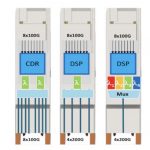
Coherent optical modules overcome these limitations by detecting amplitude, phase, and polarization. They combine advanced modulation (e.g., QPSK, QAM with dual-polarization) with high-performance digital signal processing (DSP). This approach enables longer transmission reach, higher spectral efficiency, and better scalability.
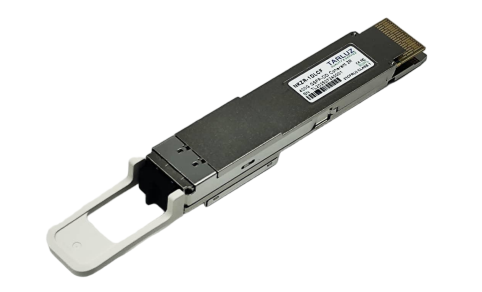
Extending transmission reach
Coherent modules use real-time DSP to compensate for fiber impairments such as chromatic dispersion, polarization mode dispersion, and frequency offsets—without requiring external dispersion compensation modules or frequent signal regeneration. Coherent detection also improves receiver sensitivity, allowing reliable signal recovery under lower optical signal‑to‑noise ratio (OSNR) conditions. This supports longer spans between amplifiers and reduces the need for high launch power. Together, these features enable transmission distances from tens to hundreds of kilometers (80 km to 400+ km), making coherent optics ideal for metro and regional DCI.
Improving energy efficiency
Coherent modules improve energy efficiency at the system level. By carrying higher data rates per wavelength, they reduce the number of transceivers, optical channels, and associated hardware. Although an individual coherent module may consume more power than a short‑reach IM‑DD module, the overall power consumption per bit is much lower. Advances in photonic integration and DSP efficiency further reduce energy use per transmitted bit. Additionally, longer reach means fewer intermediate nodes, amplifiers, and dispersion compensators, which simplifies network architecture and lowers cumulative energy consumption across the entire DCI infrastructure.
In summary, coherent pluggable modules enable longer, more spectrally efficient DCI links while significantly improving overall energy efficiency—key enablers for supporting growing data traffic and AI workloads.