

What is an Optical Attenuator?
An optical attenuator is a passive optical component that consumes energy and contains light-absorbing material. Its function is opposite to that of an optical amplifier; it is used to reduce the optical signal power in an optical fiber.
Why Use an Optical Attenuator?
The receiver of an optical module has an overload point. If the optical power reaching the receiver is too high, it may burn out the optical module. To avoid this, an optical attenuator is needed to actively reduce the optical power. In addition, in wavelength division multiplexing (WDM) systems, the optical power signals in each channel need to be approximately the same to prevent performance degradation caused by uneven optical power. Therefore, an optical attenuator is used to balance the optical power across channels.
Types of Optical Attenuators
Depending on whether the attenuation is variable, optical attenuators can be divided into fixed optical attenuators and variable optical attenuators.
Fixed Optical Attenuator
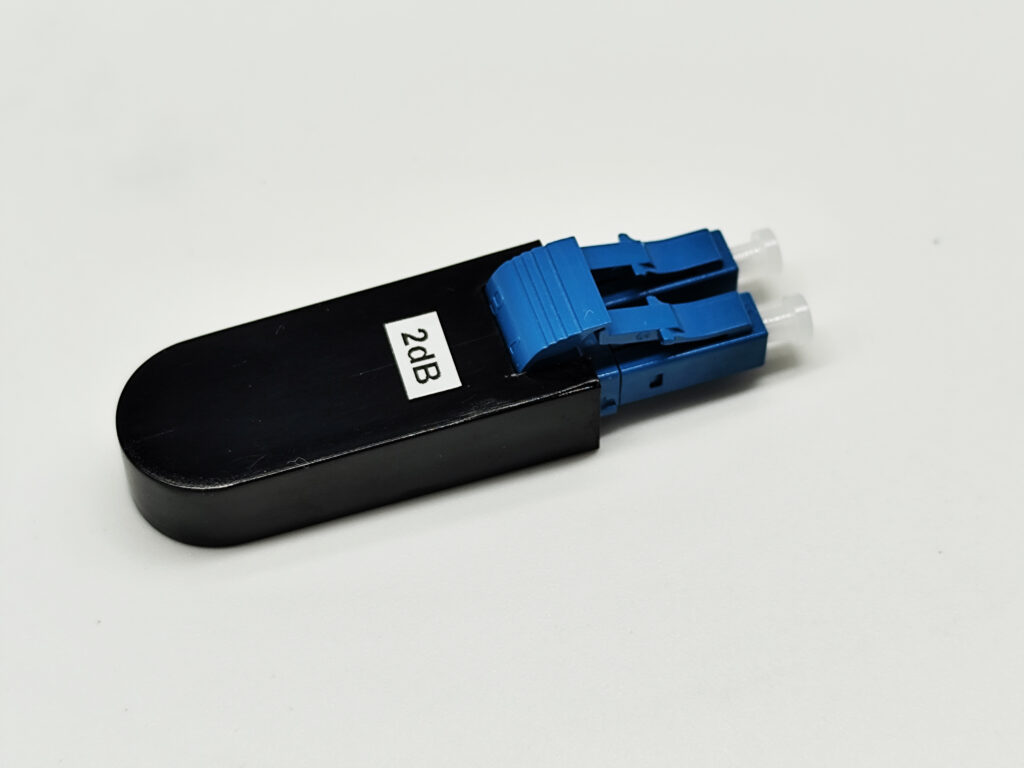
A fixed optical attenuator provides a fixed amount of optical power attenuation in a fiber link, such as 3 dB, 5 dB, 10 dB, etc., theoretically any value. This type of attenuator is available with various connector types, including FC, SC, ST, and LC. It has a simple structure, is easy to use, and has low cost. It is typically installed at the transmitting end of active modules such as OTU and OSC to prevent excessive output optical power from burning out the downstream receiving module. The disadvantage is that its attenuation is fixed, making it less flexible to use.
Variable Optical Attenuator (EVOA)
When adjusting an EVOA, the attenuation can be changed by applying an electrical drive signal, making adjustment very convenient. Therefore, EVOA supports remote commissioning. Commissioning personnel do not need to visit the site; they can simply issue commands from a remote network management center to adjust the attenuation value of the EVOA. As a result, EVOAs are mainly used in current networks.
Performance Specifications of Optical Attenuators
Attenuation and Insertion Loss
Attenuation and insertion loss are important specifications of optical attenuators. For a fixed optical attenuator, the attenuation value is essentially its insertion loss. For a variable attenuator, in addition to the attenuation range, there is a separate insertion loss specification. In practice, when selecting a variable attenuator, the lower the insertion loss, the better. A variable attenuator has an adjustment range, e.g., 1.5–15 dB, meaning that the attenuation of this variable attenuator can be set to any value within 1.5–15 dB (subject to attenuation accuracy).
Attenuation Accuracy
Attenuation accuracy is an important specification of optical attenuators. It indicates the error between the actual attenuation value and the set value. Generally, the higher the attenuation accuracy, the higher the cost.