

Massive AI clusters are pushing traditional pluggable optics to their physical limits in power, cooling, and density. As traffic surges, the industry requires a solution that balances high-performance integration with the operational ease of standard modules. This article explores how XPO (eXtra-dense Pluggable Optics) bridges this gap, providing a transformative path for scaling AI infrastructure efficiently.
What Is XPO?
XPO represents a fundamental shift in optical design for large‑scale AI clusters. It preserves the familiar front‑panel pluggable form factor that engineers trust, ensuring seamless integration into standard networking hardware. This design maintains the field‑serviceability vital for uptime in high‑scale AI networking environments.
At its core, XPO achieves high‑density integration by rethinking the mechanical and electrical architecture of the optical module. It optimizes internal photonics and thermal paths to support capacities up to 12.8 Tbps per module. By effectively balancing these performance gains with robust heat management, XPO enables data centers to scale infrastructure efficiently.
XPO Transceivers: Powering the Future of AI Networking
As AI workloads demand higher bandwidth, optical infrastructure must evolve to keep pace. XPO transceivers reimagine pluggable optics to meet these challenges, enabling high‑performance scaling while maintaining the operational simplicity essential for modern data centers.
High Bandwidth and Density
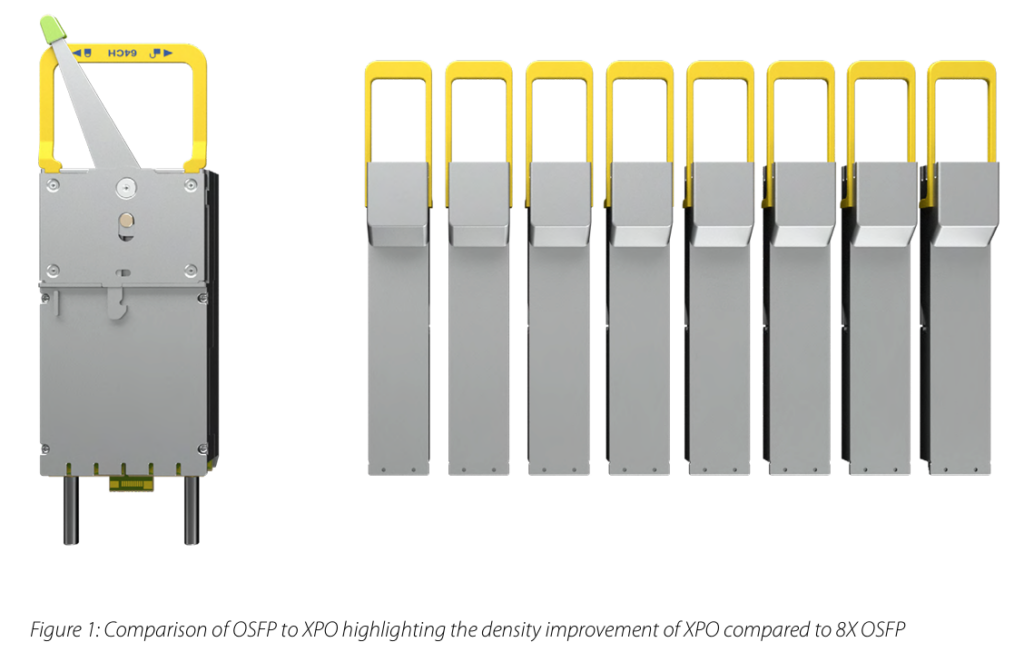
XPO modules significantly enhance network scalability by delivering 12.8 Tbps of bandwidth in a highly compact footprint. This advanced capability allows network architectures to scale up to 204.8 Tbps of switching throughput per Open Rack Unit (1OU)—a fourfold increase in front‑panel density compared to conventional OSFP modules.
By delivering massive capacity within standard rack footprints, XPO enables data centers to scale throughput efficiently. This approach offers infrastructure teams a clear pathway to bandwidth growth without requiring a larger, more complex switch chassis.
Integrated Liquid Cooling
To address the extreme thermal loads of high‑power AI environments, XPO modules feature native liquid cooling through integrated cold plates. This built‑in thermal capability allows the module to reliably support power loads exceeding 400W by pulling heat directly from high‑power optical engines.
By maintaining component temperatures 20–25°C lower than traditional air‑cooled alternatives, XPO ensures stable module operation and mitigates overheating risks. This targeted approach provides a robust thermal foundation for demanding AI networking workloads.
Optimized Power and Signal Efficiency
XPO modules enhance overall data center sustainability by leveraging high‑quality linear interface channels that improve signal integrity. This design enables the option to bypass power‑intensive digital signal processors, drastically reducing per‑module power consumption and minimizing latency.
By streamlining electrical loads and optimizing power conversion, XPO allows operators to increase network capacity efficiently. This simplified approach helps keep power usage within the operational limits of existing infrastructure without placing excessive strain on power delivery systems.
Enterprise‑Grade Reliability
Reliability is a critical differentiator for XPO, specifically optimized to prevent costly job interruptions in large‑scale AI training fabrics. By improving signal integrity and operating at lower, more stable temperatures, the module significantly enhances reliability per transmitted bit.
Furthermore, by adhering to standard MSA form factors, XPO preserves the operational simplicity of pluggable optics. This seamless interoperability allows data centers to integrate high‑density modules into existing workflows, simplifying supply chain management while offering a dependable foundation for mission‑critical workloads.
How Does XPO Transform Data Center Deployments?
Scaling AI clusters requires a balance between high‑performance connectivity and operational efficiency. XPO technology addresses this by transforming how data centers deploy and maintain high‑speed networks. The following sections outline how this architecture optimizes network topology, space utilization, and system reliability.
Simplifying Network Topology
By significantly increasing port capacity per switch, XPO can enable higher front‑panel bandwidth density, which may support flatter network designs in some AI cluster deployments. This can help reduce the number of switching stages in some large‑scale AI fabrics, potentially lowering the overall hop count.
Such a reduction in network layers can decrease communication latency for bandwidth‑intensive tasks. By simplifying the underlying connectivity, XPO supports more efficient data exchange, which is essential for optimizing the performance of large‑scale AI networking workloads.
(For broader insights into high‑speed connectivity and scaling infrastructure for modern AI, further reading is available from industry sources.)
Space and Cable Optimization
Compared to OSFP pluggable solutions, the high‑density design of XPO can improve cable density and rack‑level space utilization. This consolidation helps reduce airflow obstruction, creating clearer paths for cooling and simplifying routine cable management for IT teams.
Data centers can improve network connectivity density per square foot by leveraging such increased port density, freeing up valuable rack space. This improved physical efficiency offers a flexible way to scale infrastructure without requiring immediate or disruptive facility changes.
Streamlined Operational Maintenance
Because XPO retains hot‑swappable functionality, it provides a distinct serviceability advantage over co‑packaged optical configurations. If a module requires attention, technicians can typically replace it on‑site without extensive system disruption, subject to platform design and operational policy.
This modular design lowers operational risks by avoiding the inherent complexity of servicing integrated hardware components. Such flexibility supports higher system availability and operational responsiveness, offering a more manageable approach to long‑term maintenance in large‑scale data center environments.
Conclusion
Next‑generation AI infrastructure planning requires shifting from single‑point performance to holistic cluster efficiency. Adopting standardized XPO technology allows architecture teams to effectively address bandwidth, thermal, and maintenance challenges. This approach offers a sustainable path forward, ensuring data centers can meet the scaling demands of the AI era.