

What is Multimode Fiber (MMF)?
Multimode fiber (MMF) has a core diameter of 50 µm or 62.5 µm, enabling it to support multiple propagation modes. These modes travel at different speeds and phases, which can lead to issues such as signal delay, spectral broadening, and dispersion over long-distance transmission. As a result, multimode fiber is typically used for short-distance, low-speed transmissions, such as internal network connections within data centers.
How to estimate the number of modes?
In a multimode optical fiber, the number of supported propagating modes depends on the fiber’s core dimensions, refractive index, and the wavelength of the transmitted light wave. By calculating the V-number (normalized optical frequency), the number of modes supported by the fiber can be estimated. The V-number is a dimensionless quantity used to describe the waveguide properties of the fiber, and it is closely related to the fiber’s structural characteristics and the wavelength of light.
Formula for the V-number: 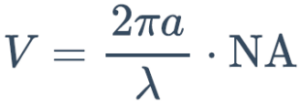
Where:
a is the fiber core radius;
λ is the free-space wavelength of the light wave;
NA is the numerical aperture of the fiber.
For example, assume a multimode fiber with a core diameter of 50 µm and a numerical aperture of 0.22. The V-number at a wavelength of 850 nm can be calculated using the formula:
V = (2π * a * NA) / λ
V = (2 * 3.1416 * 25 * 0.22) / 0.85
V ≈ (34.557) / 0.85
V ≈ 40.65
A higher V-number indicates that the fiber can support a larger number of propagating modes. For a multimode fiber, the number of modes can be estimated using the following formula:
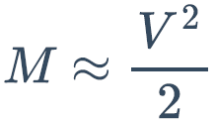
For the multimode fiber with a V-number of 40.65 calculated earlier, it can support approximately 826 different guided modes, all of which can propagate simultaneously in the fiber.